<p class="text-danger">.Next major site update: end of june, end of july 2024</p>
Survey of 18-35 year olds in the Barcelona, Bordeaux, București and Lausanne neighbourhoods
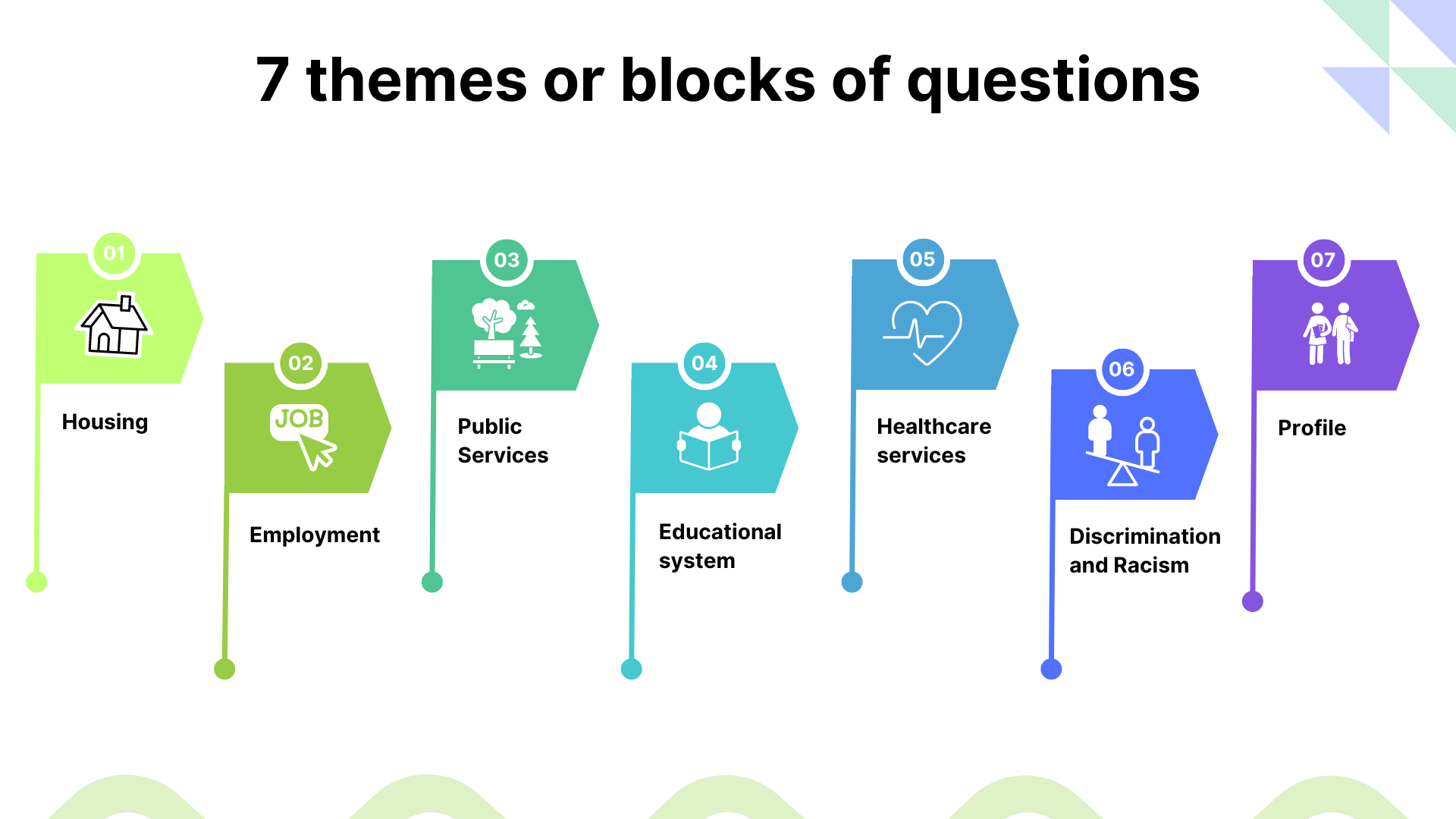
In order to generate knowledge about the discrimination experienced by young people in Europe, surveys of young people (aged 18-35) in local neighbourhoods have been carried out on the basis of survey questionnaires drawn up in collaboration by all the researchers involved in the project. Joint questionnaires have been drawn up to compare the results for each field of study (housing, employment, education and health), and the surveys will take place in 2023 in 4 cities.
The survey
Objectives
The aim of the survey, which was carried out among young people in different neighborhoods in the cities of Barcelona, Bordeaux, București and Lausanne, was to understand any difficulties they might have in accessing housing, employment, education and healthcare. The lack or absence of opportunities is also assessed in these surveys.
The surveys also ask whether they have observed any practices in the 4 sectors that restrict access to certain minorities or categories of people in the course of their lives.
The aim is also to document cumulative and lasting experiences reflecting inequalities in access and opportunities in the 4 sectors studied by this target population (segregated neighborhoods, universities). In these surveys, the questions asked will relate not only to perceived discrimination, but also to the difficulties encountered by the population in the course of their lives in each study sector. The information collected covers:
Information on the potential vectors of discrimination (age, gender, origin, disability, religious symbol, area of residence) in each of the areas.
Information on potential vulnerabilities in the 4 areas (standard of living (income), level of education, type of job and employment contract (precarious or not), quality of housing, access to healthcare or not).
Information on social inclusion (in relation to loneliness) and on the feeling of belonging to a group, a geographical area, a religion, etc.
Information on changes in respondents’ situation after the COVID shock (deterioration or not).
Based on the responses, the aim will be to establish respondent profiles and, in particular, vulnerability profiles: who are these young people who are experiencing unequal treatment in the areas mentioned. Are these experiences cumulative ?
Protocol
The questionnaires for young people living in the neighborhoods of the four cities (Barcelona, Bordeaux, Bucharest, and Lausanne) were carried out between April 2023 and June 2023. The surveys were carried out on the various sites by teams of interviewers who had been trained beforehand (see deliverable 5.1: interviewer training guide).
All the quantitative questionnaires were validated by the RDGP and the ethics advisor. Adaptations had to be made to take account of the specific nature of the sites: the questionnaires contain differences which are indicated in the metadata.
The questionnaires
Events
In Bordeaux, 2 events were organised following the quantitative surveys. They provided an opportunity for exchanges with local partners, interviewers and respondents… a valuable tool for qualifying work on past (quantitative) and future (qualitative) surveys.
EDITATHON

25rd November 2023: Wikipedia training and contribution workshop Diversity bias on Wikipedia. Women in research.
https://fr.m.wikipedia.org/wiki/Projet:Les_sans_pagEs/Bordeaux/UNdeterred
SCREENING & DISCUSSION
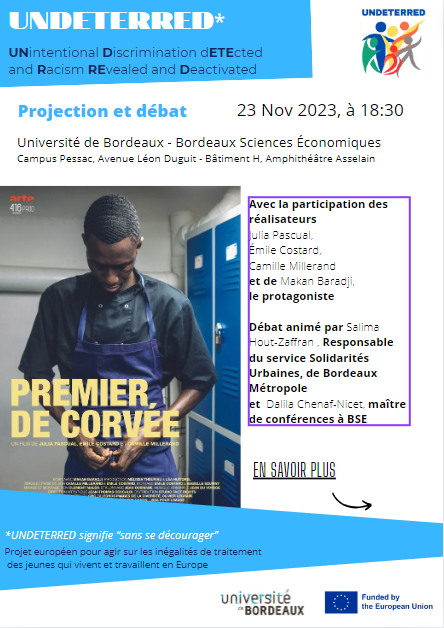
Screening and discussion of the film ‘Premier de corvée’ at the University of Bordeaux with the participation of the directors and the protagonist.
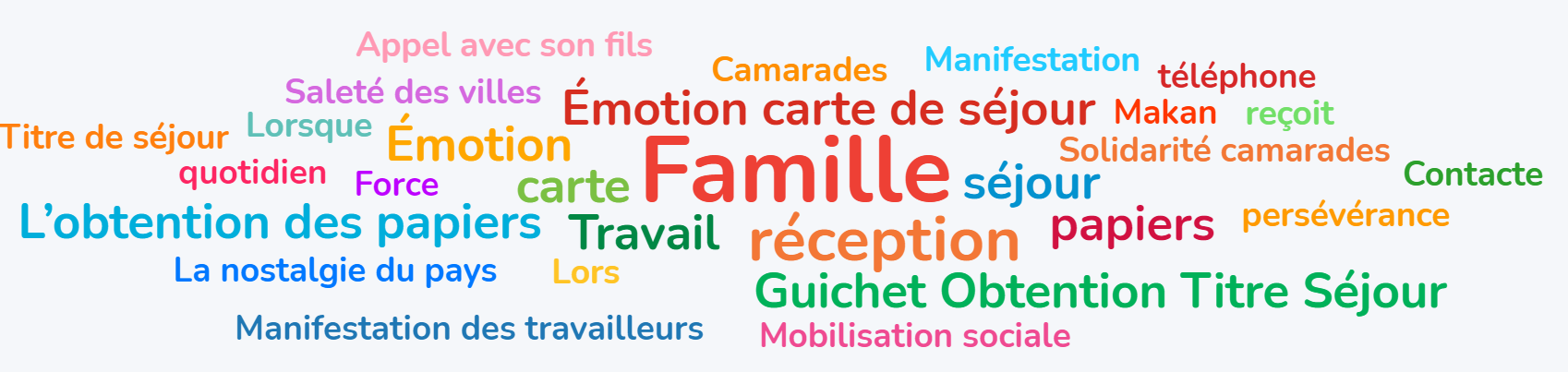
Quizz - In this documentary, what was the most memorable moment for you?
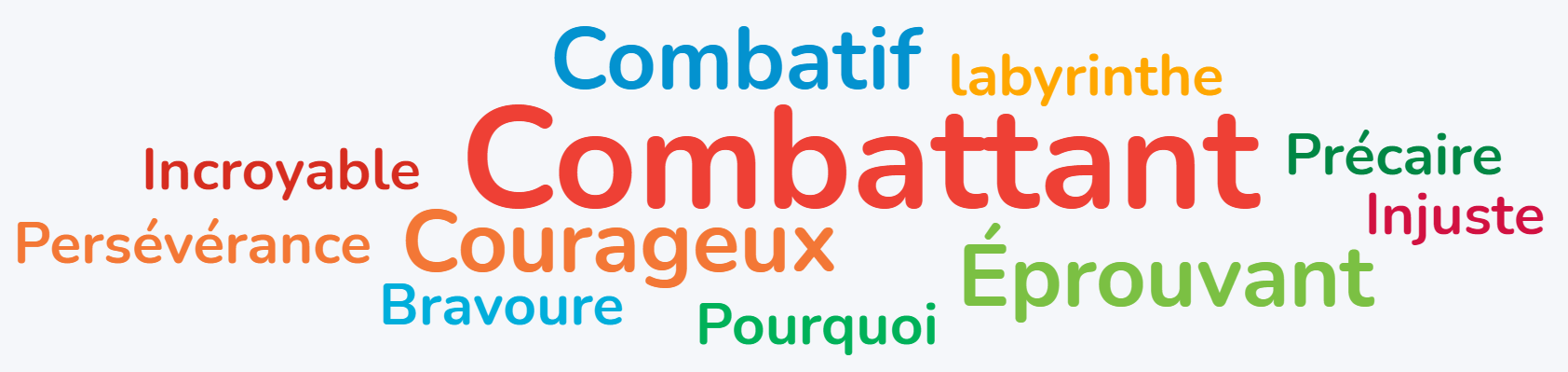
Quizz - In a nutshell, how would you describe Makan’s career?
© 2024 Karine Onfroy - Bordeaux School of Economics (BSE) - Université de Bordeaux. Tous droits réservés.